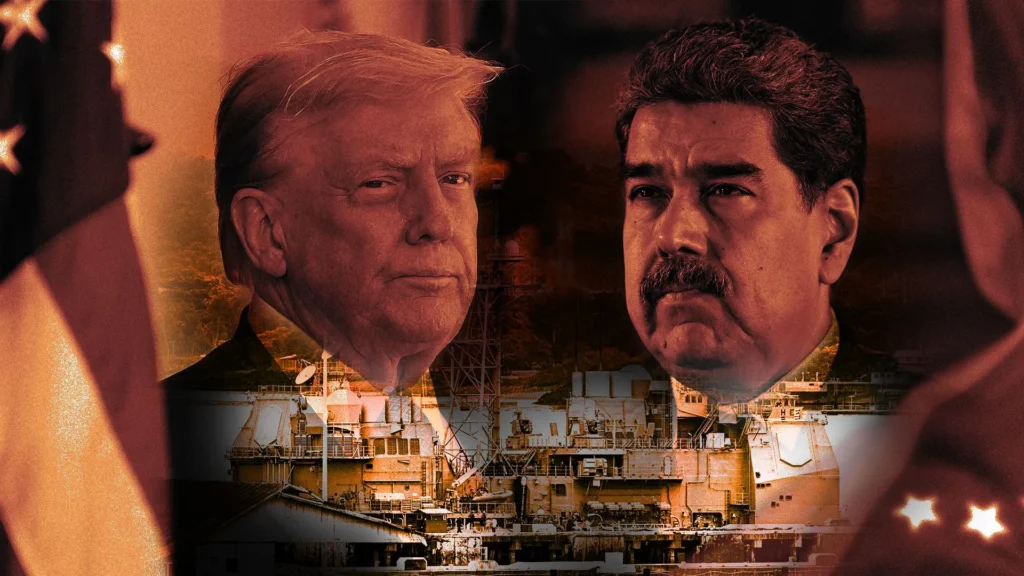
Operation Bolivar examines the reported capture of Nicolás Maduro and how silence, ambiguity, and precedent are reshaping power across the Western Hemisphere in real time.
SECTION I : Prologue — The Night Nicolás Maduro Disappeaars
It doesn’t begin with explosions.
There is no televised address, no live footage of helicopters lifting off, no grainy night-vision clips looped endlessly on cable news. There are no early leaks, no anonymous briefings to legacy outlets, no advance warnings whispered through diplomatic channels.
There is just silence.
Then, at 4:21 a.m. Eastern, that silence breaks — not with a press conference or a Pentagon statement, but with a post on Truth Social from Donald J. Trump.
The message is blunt. Declarative. Written without qualifiers or visible hesitation. It claims that the United States has carried out a large-scale operation in Venezuela and that President Nicolás Maduro — along with his wife — has been captured and removed from the country. A press conference is promised later in the morning.
No evidence is attached.
No images.
No video.
No corroboration.
Just a statement, dropped into the global bloodstream before dawn.
And then nothing else.
A Claim Without Context
Within minutes, the post is everywhere.
Screenshots spread faster than fact-checks can keep up. Newsrooms scramble to confirm whether the account has been compromised. Analysts refresh embassy feeds, military channels, regional government accounts — looking for anything that either confirms or contradicts the claim.
For a brief window, no one knows what to believe.
The allegation is enormous. If true, it would represent one of the most dramatic unilateral actions in modern hemispheric history. If false, it would be an unprecedented provocation — one likely to trigger immediate diplomatic and security consequences.
Yet in the first hour, there is no official response from Caracas.
No denial.
No emergency broadcast.
No grainy appearance from Maduro himself.
That absence becomes its own data point.
What We Know — And What We Don’t
As of this writing, there is no independently verified visual evidence that Nicolás Maduro has been captured. There are no confirmed images of an operation, no footage of arrests, no public confirmation from U.S. military leadership, intelligence agencies, or international observers.
There are also no clear signs that the Venezuelan government is functioning normally.
Reports — unconfirmed, fragmentary — suggest communications disruptions in parts of Caracas. Some accounts describe unusual military movement. Others report nothing at all. Social media from inside Venezuela becomes inconsistent, with long gaps followed by bursts of conflicting claims.
It is impossible, at this stage, to separate signal from noise.
What is clear is that something has happened — or is happening — that has disrupted the normal information flow.
And that disruption is not accidental.
The Power of Saying It First
Whether the claim ultimately proves accurate or not, its delivery is already consequential.
This is not how regime change is normally announced.
It is not how arrests of heads of state are usually revealed.
It is not how international crises are supposed to begin.
By posting first — without institutional framing, without visible process — Trump seizes narrative primacy. He forces every other actor, domestic and foreign, into reaction mode.
Governments are not responding to an operation.
They are responding to an assertion.
And in geopolitics, assertions matter — especially when they are not immediately disproven.
Caracas, in the Dark
Inside Venezuela, information is scarce.
There are no televised appearances from senior officials.
State media cycles through pre-recorded programming.
Rumors move faster than confirmations.
Some reports describe checkpoints reappearing overnight.
Others suggest internal confusion within security forces.
None of it is verified.
The most striking feature of the moment is not visible violence, but informational vacuum.
No hero footage.
No resistance montage.
No triumphant speeches.
Just uncertainty.
If Maduro is still in power, he is not showing it.
If he is not, no one is explaining what replaces him.
The Silence Is the Event
For decades, major geopolitical actions followed familiar rhythms: leaks, warnings, escalations, talking points, expert panels, predictive analysis.
This moment breaks that pattern.
There is no warm-up.
No justification.
No moral framing.
There is only a claim, and a world forced to sit with it.
That silence — the lack of immediate clarification, the absence of theatrical validation — may be the most destabilizing element of all.
Because it leaves every observer asking the same question:
Is this real?
And if it is, what else is possible now?
Regional Governments Hesitate
Across Latin America, early responses are cautious or nonexistent.
No coordinated condemnation.
No immediate emergency summits.
No rush to endorse or denounce.
That restraint does not suggest agreement.
It suggests calculation.
No government wants to be the first to react to a claim that could still be evolving — or unraveling. No leader wants to stake credibility on information that may be incomplete, manipulated, or deliberately ambiguous.
Waiting, for now, is safer than speaking.
Washington Is Not Explaining
In the United States, the institutional silence is just as striking.
There is no immediate Pentagon briefing.
No confirmation from intelligence agencies.
No congressional leadership statement clarifying what has occurred.
Cable news fills airtime with speculation.
Legal analysts debate hypotheticals.
Former officials speak carefully, if at all.
Everyone is waiting for someone with authority to confirm or deny what Trump has already declared as fact.
That delay matters.
A New Kind of Shock
If this is an operation — if Maduro has indeed been removed — then its most radical feature is not speed or scale, but presentation.
There is no attempt to persuade.
No effort to justify.
No narrative scaffolding erected in advance.
This is not shock and awe.
It is assertion and silence.
And that combination is unsettling precisely because it denies observers the tools they are used to using: timelines, briefings, evidence, moral arguments.
Venezuela in Suspension
On the streets of Caracas — based on scattered reports — the mood is not celebratory.
It is tense.
Confused.
Watchful.
People are not flooding public squares.
They are staying inside.
Waiting.
For confirmation.
For direction.
For signs that someone is in control.
The absence of clarity is not reassuring.
It is paralyzing.
This Is Not an Ending
Whatever the truth of Trump’s claim, one thing is already evident:
This is not a conclusion.
It is an opening.
No policy has been articulated.
No roadmap has been offered.
No future has been described.
There is only a rupture in the expected order of things.
And across the hemisphere — across the world — governments are now forced to consider a possibility they were not prepared to confront at four in the morning:
That a head of state may have been removed without warning, without visible process, and without immediate explanation.
If that possibility holds, even briefly, it changes the psychological terrain.
Not because it establishes a rule.
But because it shatters an assumption.
And in geopolitics, the loss of an assumption can be more destabilizing than the loss of a battle.
The night is not over.
The facts are not settled.
The consequences are not yet visible.
But something has shifted.
And the world is waiting to see whether the silence breaks — or hardens into a precedent.
SECTION II : The Real Target Wasn’t Nicolás Maduro — It Was the Message
In the hours following the reported capture of Nicolás Maduro, analysts fixated on mechanics.
How it was done.
Who authorized it.
Whether it was a military action, an intelligence operation, or something deliberately blurred in between.
But those questions miss the larger point.
Because whatever this operation ultimately proves to be, it was never just about Venezuela.
It was about demonstration.
Maduro was not merely a target — he was a test case. A visible example designed to force every other power center to ask the same quiet question:
If this is real… what does it mean for us?
A Line Was Crossed — Or Appeared To Be
For decades, U.S. power operated inside a familiar choreography. Even when norms were bent, there were rituals:
- sanctions before strikes
- coalitions before invasions
- legal frameworks, however strained
Direct action against sitting heads of state remained rare, deniable, or retroactively justified as wartime necessity.
What made the Maduro operation different wasn’t just its audacity — it was the absence of explanation.
No resolution.
No coalition.
No articulated casus belli.
Just an assertion of fact — delivered via social media — from President Trump
Whether or not this marks a permanent shift in doctrine, the perception alone is destabilizing.
Because deterrence doesn’t require repetition.
It only requires plausibility.
Strategic Decapitation Without Commitment
What followed was just as telling as what didn’t.
There was no immediate reconstruction plan.
No interim government presented.
No rhetorical commitment to democracy promotion or nation-building.
That absence matters.
It suggests the operation — if confirmed as described — was not about transformation, but interruption. A deliberate severing of leadership without assumption of responsibility for what followed.
In strategic terms, that’s not regime change.
It’s decapitation as messaging.
Who Was Really Watching
The audience for this operation was never confined to Caracas.
Security establishments elsewhere would have viewed it not as a Venezuelan event, but as a stress test:
- Of U.S. reach
- Of deniability
- Of escalation thresholds
Not because Maduro was uniquely threatening — but because he was accessible.
A figure significant enough to matter, yet isolated enough to avoid immediate great-power retaliation.
A middle-tier authoritarian whose removal could signal capability without forcing immediate confrontation with Beijing, Moscow, or Tehran.
Narrative Shock as a Force Multiplier
What unfolded next wasn’t conventional military signaling — it was information shock.
Before any formal clarification:
- social platforms filled the vacuum
- denial and confirmation competed simultaneously
- speculation outran verification
By the time official statements emerged, the story had already metastasized.
This wasn’t an accident.
Modern power doesn’t just move hardware — it manipulates tempo. The faster the narrative spreads, the less room there is for coordinated response.
Control the timing, and you control the terrain.
Donald J. Trump as Vessel, Not Architect
Whether Trump initiated the operation, approved it, or merely announced it remains unclear.
But his role was symbolically sufficient.
He didn’t explain.
He didn’t justify.
He simply claimed.
In a media ecosystem driven by engagement, that mattered more than legality.
The performance was the policy.
The Silence That Followed
Perhaps most notable was the lack of visible internal dissent.
No public resignations.
No immediate leaks condemning recklessness.
No coordinated pushback from retired officials.
That silence doesn’t confirm consensus — but it does suggest hesitation to challenge the narrative.
And in power politics, hesitation is its own form of acquiescence.
What This Actually Changed
It is too early to declare a new doctrine.
But it is not too early to say this:
A boundary was tested.
A signal was sent.
And the world took note — not of the legality, but of the possibility.
Maduro may not have been the beginning of a new era.
But he may have been its announcement.
And in an age where perception often outruns proof, that alone is enough to unsettle every palace, bunker, and secure compound watching the feed.
SECTION III: The Fallout Is Already Starting — Quietly
Only a few hours have passed since Nicolás Maduro was reportedly taken into U.S. custody.
That matters more than almost anything else.
Because at this stage, there is no aftermath yet — only initial reactions, partial signals, and conspicuous absences. There are no stabilized narratives. No settled interpretations. No authoritative timelines. Anyone claiming to see the full shape of the fallout right now is either guessing, laundering an agenda, or trying to seize narrative ground before facts solidify.
But the absence of clarity does not mean the absence of meaning.
Even in these first hours — while statements are still being drafted, while intelligence services are still verifying, while governments are still deciding whether to speak at all — patterns are emerging.
And they are not the patterns most people were primed to expect.
What Hasn’t Happened Is the Story
There has been no immediate cascade.
No emergency United Nations session hastily announced.
No unified condemnation from Latin American governments.
No calls for sanctions or retaliatory measures.
No mass mobilization in the streets.
No dramatic market collapse signaling systemic panic.
Instead, the reaction so far has been strangely muted.
Oil prices jumped sharply, then leveled.
Regional currencies twitched, then stabilized.
Equity markets reacted, corrected, and paused — as if waiting for confirmation that this is real before deciding how seriously to take it.
Governments have issued statements that say very little, very carefully. Others have said nothing at all.
This restraint is not calm.
It is assessment.
Right now, nearly every capital in the hemisphere — and many far beyond it — is doing the same three things in parallel:
- verifying whether the reported facts hold
- waiting to see how Washington follows up
- watching whether anyone else moves first
Because in moments like this, the first reaction rarely matters as much as the second.
The initial action creates shock.
The follow-up reveals intent.
And until intent is clarified, movement is risk.
The Hemisphere Is Holding Its Breath
This early silence should not be mistaken for approval, compliance, or fear.
It is something colder than all three.
Latin American governments — particularly those governing fractured coalitions, volatile economies, or publics already stretched thin by inflation, crime, and institutional distrust — are trying to answer one central question before saying anything meaningful:
What, exactly, just happened?
Not rhetorically.
Operationally.
Was this:
- a one-off political spectacle?
- a narrow intelligence-driven extraction?
- a contingency triggered by new information?
- or the opening move in something broader, less defined, and potentially repeatable?
Each answer carries radically different implications.
Until that question resolves — or until Washington resolves it for them — committing to a public position is dangerous. What sounds principled in the morning can sound reckless by nightfall.
This is what uncertainty looks like at the state level: not chaos, but paralysis masked as composure.
The Monroe Doctrine Question Is Back — Unspoken
No one is invoking the Monroe Doctrine explicitly.
No speeches.
No op-eds dusting off 19th-century language.
No official references to hemispheric red lines.
But it would be naïve to believe no one is thinking about it.
For decades, Washington has treated hemispheric dominance as something to deny rhetorically while maintaining structurally. U.S. officials spoke the language of partnership, multilateralism, and regional autonomy — even as military cooperation agreements, intelligence-sharing frameworks, and economic leverage quietly preserved American primacy.
What happened today forces that contradiction into the open.
If a sitting Latin American head of state can be removed without advance warning, coalition-building, or public justification — if such an action can be announced after the fact rather than debated beforehand — then the long-held assumption that U.S. influence in the hemisphere is constrained primarily by optics is no longer safe.
Whether this was intentional signaling or not is almost irrelevant.
The effect is the same.
Regional Leaders Aren’t Reacting — They’re Repositioning
There is, at this moment, no evidence of coordinated resistance.
No joint statements.
No emergency summits.
No bloc-level denunciations.
What is visible already is far subtler:
- carefully neutral language
- avoidance of emotionally loaded phrasing
- repeated emphasis on “monitoring developments” and “seeking clarification”
That language is not moral.
It is tactical.
Leaders are not asking, “Do we agree with this?”
They are asking something far more personal and far more dangerous:
Could this happen to us — and under what conditions?
That calculation has nothing to do with ideology and everything to do with exposure.
It forces leaders to re-examine:
- how isolated they are diplomatically
- how penetrable their security services might be
- how dependent they are on a narrow set of external patrons
In moments like this, alignment matters less than visibility. The goal is not to challenge power — it is to avoid becoming an example.
Cuba, Nicaragua, and the Problem of Reachability
For smaller, more isolated regimes, the implications are immediate — even if no public statements reflect it yet.
The threat is no longer invasion.
It is extraction.
That distinction matters.
Invasion is expensive.
Invasion is visible.
Invasion invites global response.
Extraction is quieter.
More ambiguous.
Harder to rally against.
A state does not need to be occupied to be destabilized.
It only needs to be penetrable enough that its leadership can no longer assume physical invulnerability.
That realization changes internal conversations immediately:
- security protocols get revisited
- travel schedules get reconsidered
- inner circles tighten
- trust narrows
None of that will be visible from the outside — at least not yet.
But those conversations are happening now.
Beijing and Moscow Are Watching — Not Interrupting
There has been no loud reaction from Beijing or Moscow.
That silence should not be misread as indifference or weakness.
It signals triage.
Neither power has an immediate obligation to respond. Venezuela is not a treaty ally. There is no automatic defense clause to invoke. A public overreaction at this stage would only legitimize the event before its parameters are fully understood.
So they are doing what serious power centers do in moments of uncertainty:
- observing
- recording
- measuring
This is not a moment for countermoves.
It is a moment for data collection.
What matters to Beijing and Moscow right now is not rhetoric, but signal strength:
- Was this clean or chaotic?
- Narrow or broad?
- Repeatable or situational?
- Was this done with institutional backing, or personal authority?
Those answers will determine future responses — not today’s headlines.
The Most Dangerous Variable Right Now: Ambiguity
At this hour, the most destabilizing factor is not fear.
It is uncertainty.
No one outside a very small circle knows:
- how narrowly this was authorized
- what intelligence triggered it
- whether it applies only to Venezuela
- whether it can be repeated elsewhere
That ignorance forces governments to plan for multiple futures simultaneously.
And that is destabilizing by itself.
Ambiguity drains bandwidth.
It fractures consensus.
It prevents coordination.
This is not a flaw in the operation’s aftermath.
It may be its most effective feature.
Ambiguity is not a bug here.
It is the payload.
Venezuela Isn’t Being “Liberated” — And That’s Already Clear
Even at this early stage, one thing is unmistakable:
There is no liberation narrative unfolding.
No reconstruction messaging.
No democracy road map.
No humanitarian framing dominating the information space.
Whatever this was, it was not sold as salvation.
It was presented as capability.
That distinction matters enormously — because it shapes how other governments interpret American intent. Not as a partner offering rescue, and not as an occupier promising order, but as a power willing to act selectively without assuming responsibility for outcomes.
That is a colder posture.
And a more destabilizing one.
Where Things Stand Right Now
As of this moment:
- no regional consensus has formed
- no counter-coalition has emerged
- no doctrine has been articulated
- no escalation has occurred
But something has changed anyway.
The assumption that nothing like this would happen is gone.
And in geopolitics, losing an assumption — especially one as foundational as that — can be as destabilizing as losing a war.
The silence, the hesitation, the careful language, the waiting — all of it points to the same reality:
The hemisphere is not reacting yet.
It is recalculating.
And what happens next — not what happened today — will determine whether this moment hardens into precedent or collapses into anomaly.
SECTION IV (Real-Time): Why Silence Is the Strategy — And the Risk
Silence, in moments like this, is not an absence.
It is an action.
In the hours since Nicolás Maduro reportedly vanished from public view, the most striking feature of the global response has not been outrage, celebration, or mobilization — but withholding. Information is being rationed. Statements are being delayed. Confirmations are being avoided.
That is not confusion.
It is strategy.
Because right now, clarity would be destabilizing.
Silence as Control
In conventional crises, governments rush to shape the narrative. They brief allies, prepare talking points, frame legality, and flood the media with context before speculation fills the void.
That has not happened here.
Instead, nearly every institutional actor — Washington included — appears to be doing the opposite: allowing ambiguity to linger.
Why?
Because ambiguity shifts leverage.
When facts are incomplete, power concentrates in the hands of whoever knows more than they are saying. Silence forces everyone else to guess — and guessing is inherently destabilizing.
Right now:
- foreign governments cannot calibrate responses
- markets cannot price risk accurately
- institutions cannot coordinate
- publics cannot anchor their emotions
Silence freezes the board.
And frozen boards favor actors already holding initiative.
Washington’s Calculated Non-Answer
The most consequential silence is coming from the United States itself.
As of this moment, there is:
- no detailed Pentagon briefing
- no formal intelligence confirmation
- no legal framing
- no articulated objective
Even the promised press conference looms as a question mark: will it clarify, or simply assert?
That restraint is deliberate.
Any explanation would immediately raise secondary questions:
- Under what authority was this done?
- Who approved it?
- What precedent does it set?
- Does it apply elsewhere?
Answering one question would invite ten more.
By saying nothing — or by saying only the bare minimum — Washington keeps all options open. It avoids being locked into a narrative that might later collapse under scrutiny or require escalation to defend.
Silence preserves maneuverability.
The Information Vacuum Is the Battlefield
In the absence of official clarity, something else rushes in.
Speculation.
Theories.
Leaked “sources.”
Influencer analysis.
Misinformation dressed as insight.
This is not a side effect.
It is the terrain.
Modern power is exercised not just through action, but through tempo — controlling how fast information moves relative to verification. When claims outrun confirmation, perception becomes reality for millions of people long before facts catch up.
Right now, the world is not responding to what happened.
It is responding to the possibility that it happened.
That distinction matters.
Why Allies Are Also Staying Quiet
The silence is not limited to Washington.
Traditional U.S. partners — in Latin America and beyond — are also avoiding definitive statements. Even governments that might privately welcome Maduro’s removal are hesitating to say so publicly.
Why?
Because premature endorsement carries risk.
If the claim proves exaggerated, false, or incomplete, early supporters would be exposed. If it proves accurate but controversial, endorsers could be accused of complicity. And if it sets a precedent, today’s applause could become tomorrow’s vulnerability.
Silence buys time.
Time to assess.
Time to verify.
Time to see whether the United States owns what it has implied — or retreats behind ambiguity.
Silence as Psychological Pressure
Silence is not neutral. It exerts pressure.
Inside Venezuela, uncertainty magnifies fear. Without clear authority, rumors fill the gap. Without official messaging, every sound becomes suspicious, every movement potentially meaningful.
In neighboring countries, the lack of explanation forces leaders to imagine worst-case scenarios. If this happened once, could it happen again? If so, under what conditions? Who decides?
Globally, silence invites recalculation.
The absence of denial is as powerful as confirmation.
The Risk: When Silence Stops Working
But silence is not free.
It carries serious risks — and they grow over time.
The longer ambiguity persists, the more actors begin to act independently. Markets hedge aggressively. Governments quietly adjust security postures. Intelligence services assume hostile intent by default.
At a certain point, silence no longer preserves stability.
It creates volatility.
Because uncertainty does not remain suspended forever. It collapses — often violently — into assumption.
And assumptions are how miscalculations begin.
The Domestic Risk Inside the United States
Silence also carries internal consequences.
In the absence of explanation, the American public is left with a claim of extraordinary power exercised without visible process. That erodes norms even among supporters.
If a president — current or former — can announce the capture of a foreign head of state without immediate institutional corroboration, it raises uncomfortable questions about where authority actually resides.
Silence may protect operational flexibility.
But it weakens democratic accountability.
That tension will not resolve itself quietly.
Silence vs. Legitimacy
Legitimacy requires explanation.
Not immediately.
Not fully.
But eventually.
At some point, silence must give way to narrative — or be replaced by others’ narratives.
Already, alternative explanations are proliferating:
- secret deals
- staged extractions
- misinformation operations
- internal Venezuelan betrayals
- foreign intelligence entanglements
Each hour without clarification allows these stories to harden.
Once they do, even the truth — when released — may not dislodge them.
That is the central risk of silence: it surrenders authorship of meaning.
The Narrow Window
Silence is most effective in short bursts.
It disorients.
It delays response.
It forces recalculation.
But it has a shelf life.
Eventually:
- allies will demand clarity
- adversaries will test boundaries
- institutions will leak
- markets will force disclosure
When that happens, the narrative must already exist — or it will be written by others.
That window is open right now.
It is closing.
Why This Moment Is So Precarious
What makes this moment uniquely dangerous is not what has been done, but what has not yet been explained.
Without explanation:
- deterrence blurs into intimidation
- authority blurs into arbitrariness
- power blurs into unpredictability
Those blurs are destabilizing not just for adversaries, but for the entire international system.
Silence, if prolonged, does not freeze the board forever.
It warps it.
The Strategic Gamble
If this operation is real — and if silence is being used intentionally — then Washington is making a calculated gamble:
That uncertainty will intimidate adversaries without provoking them.
That allies will wait rather than fracture.
That domestic institutions will fall in line rather than rebel.
That no one will force the issue before control is regained.
That is a high-risk wager.
Because once silence loses its grip, the next phase begins — and that phase will not be quiet.
Where This Leaves Us — Right Now
As of this moment:
- silence is still working
- uncertainty still favors the initiator
- reactions remain muted
- escalation has not occurred
But silence is not resolution.
It is a pause.
And pauses in geopolitics are rarely peaceful — they are preparatory.
The question now is not whether the silence will break.
It is who breaks it first, and with what version of reality.
SECTION V: What Happens When Ambiguity Becomes Doctrine
Ambiguity is useful in a crisis.
Doctrine is what happens when ambiguity survives the crisis.
Right now, what surrounds the reported removal of Nicolás Maduro is still plausibly temporary: a pause, a fog, a tactical withholding of information while institutions decide how — or whether — to speak.
But if this moment resolves without clarification — if no clear legal, strategic, or moral framework emerges — then ambiguity itself risks hardening into precedent.
And that is where the danger lies.
Because ambiguity, once normalized, stops being a tool.
It becomes a rule.
From Exception to Pattern
Every major shift in international behavior begins the same way: as an exception.
An emergency.
A unique set of circumstances.
A one-off justified by urgency, secrecy, or necessity.
But systems do not remember intent.
They remember what was tolerated.
If a head of state can be removed — or credibly claimed to have been removed — without advance warning, without institutional explanation, and without immediate consequence, then the question future actors will ask is not “Was that legal?”
It will be:
“Can we get away with it?”
That is how ambiguity becomes doctrine — not through announcement, but through repetition without punishment.
The Collapse of Signaling Norms
For decades, great powers relied on signaling to manage escalation.
Signals were deliberate:
- military exercises
- diplomatic warnings
- public red lines
- private channels reinforced by public posture
They allowed adversaries to adjust behavior without losing face — or triggering war.
Ambiguity disrupts that system.
When actions occur without explanation, signals lose meaning. Silence becomes indistinguishable from preparation. Inaction becomes indistinguishable from weakness.
In that environment, restraint is no longer rewarded.
It is penalized.
Because no one knows whether waiting is prudent — or fatal.
The Copycat Risk Isn’t Hypothetical
The most destabilizing consequence of ambiguous power is not how it affects rivals.
It is how it licenses imitation.
Other states — especially those already operating on the margins of international norms — watch moments like this carefully. Not to condemn them, but to study them.
They ask:
- What justification was required?
- How much denial was enough?
- How long did silence hold?
- Who objected — and who didn’t?
If ambiguity works once, it becomes tempting elsewhere.
Not necessarily against heads of state.
Not immediately.
But against dissidents.
Exiles.
Opposition figures.
Rival elites.
Extraction, detention, disappearance — all justified not by law, but by precedent drift.
When ambiguity becomes doctrine, accountability becomes optional.
The End of the “Explain Later” Assumption
One of the most dangerous assumptions embedded in modern governance is that explanation can always come later.
That institutions can act first, then justify.
That silence can be temporary.
That legitimacy can be retroactively restored.
That assumption only holds if explanation eventually arrives.
If it does not — if ambiguity is allowed to persist — then explanation stops being expected at all.
Power becomes performative.
Authority becomes declarative.
And legality becomes secondary to momentum.
That is not authoritarianism in the classical sense.
It is something colder:
a system where clarity itself is treated as a vulnerability.
When Allies Stop Asking Questions
Ambiguity doesn’t just affect adversaries.
It reshapes alliances.
Allies rely on predictability more than dominance. They need to know:
- what actions mean
- what lines exist
- what commitments bind
If ambiguity becomes standard, allies face an impossible choice:
- demand clarity and risk alienation
- or accept silence and absorb risk
Over time, they adapt by hedging.
Diversifying partnerships.
Reducing dependence.
Quietly preparing for abandonment — or entanglement.
That erosion doesn’t look dramatic.
It looks like drift.
And drift is how alliances die.
Domestic Institutions Under Strain
Doctrine doesn’t only operate outward.
It works inward.
If ambiguity becomes the default mode of exercising power, domestic institutions are forced into reactive postures.
Legislatures are sidelined.
Courts are delayed.
Oversight becomes ceremonial.
Not because institutions are formally dismantled — but because they are never invited into the room in the first place.
The danger is not that rules are broken.
It’s that they stop being referenced.
Once that happens, restoring them requires confrontation — not clarification.
Ambiguity and the Acceleration of Miscalculation
The more ambiguity governs state behavior, the more decision-making accelerates.
Why?
Because when intentions are unclear, actors assume worst-case scenarios. They move faster. They escalate sooner. They pre-empt rather than respond.
That compresses timelines.
Diplomacy requires time.
Verification requires time.
De-escalation requires time.
Ambiguity strips that time away.
And once timelines collapse, mistakes become irreversible.
The Psychological Cost of Permanent Uncertainty
States are not abstract entities.
They are run by people.
People operating under constant ambiguity do not become cautious.
They become paranoid.
They centralize power.
They narrow trust.
They see conspiracies everywhere — because sometimes conspiracies are happening.
Ambiguity breeds fear.
Fear breeds overreaction.
Overreaction breeds conflict.
That is not a moral judgment.
It is a psychological one.
The Line Between Deterrence and Terror
Deterrence relies on clarity.
Terror relies on unpredictability.
When ambiguity becomes doctrine, the line between the two blurs.
Actions meant to signal strength can be interpreted as intimidation.
Silence meant to preserve leverage can be interpreted as threat.
Inaction meant to avoid escalation can be interpreted as preparation.
At that point, power stops stabilizing the system.
It destabilizes it.
Why This Moment Matters More Than the Outcome
The ultimate fate of Nicolás Maduro — where he is, what happens next, how Venezuela stabilizes or fractures — will matter.
But not as much as how this moment is resolved.
If clarity follows — even partial, even delayed — then ambiguity remains a tactic.
If it does not, ambiguity becomes a method.
And methods, once normalized, are hard to reverse.
The Trap of Success
There is one final risk that rarely gets discussed.
If ambiguity works — if it deters rivals, suppresses backlash, and produces short-term strategic gain — it will be reused.
Success is the most dangerous teacher.
Because it convinces decision-makers that explanation is unnecessary, accountability is optional, and silence is superior to law.
That is how doctrines are born — not through ideology, but through effectiveness.
Where We Are Right Now
At this moment:
- ambiguity still benefits the initiator
- silence still controls tempo
- reactions remain restrained
- doctrine has not yet solidified
But the window is narrowing.
Sooner or later, ambiguity must resolve into one of two things:
- clarity, which restores rules
- or normalization, which replaces them
There is no stable third option.
The Question That Now Hangs Over Everything
This is no longer just about Venezuela.
It is not even about the United States.
It is about whether the international system adapts to ambiguity — or resists it.
Whether silence remains a tactic — or becomes a template.
And whether power, once unbound from explanation, can ever be safely rebound again.
Because once ambiguity becomes doctrine, the world doesn’t become quieter.
It becomes permanently unstable.
SECTION VI: The World After Precedent
Precedent doesn’t announce itself.
It doesn’t arrive with a doctrine paper or a signature on parchment. It emerges quietly, often unnoticed, in the space between what happened and what was tolerated.
Right now, the world is still deciding whether what was claimed to have happened to Nicolás Maduro becomes precedent — or remains an anomaly suspended in ambiguity.
But the danger is not that a rule has been written.
The danger is that one may already be forming by default.
Precedent Is Not About Proof — It’s About Permission
In international politics, precedent does not require universal agreement. It does not even require full confirmation.
It requires non-reversal.
If an action is taken — or credibly claimed — and no meaningful cost follows, then the system absorbs it. Not as law, but as possibility.
That is the threshold the world is approaching now.
Whether Maduro is confirmed detained, relocated, bargaining, or something else entirely will matter. But what matters more is whether the idea that a sitting head of state can be removed without explanation survives intact.
If it does, the permission structure shifts.
And once permission shifts, behavior follows.
The New Strategic Question
For decades, the central strategic question facing leaders was simple:
What will the response be?
Now, a second question intrudes — one far more destabilizing:
What if there is no response?
That uncertainty alters calculus at every level:
- how leaders travel
- how security services prioritize threats
- how dissidents are treated
- how rivals are preempted
Precedent does not need repetition to exert force.
It only needs to remain unresolved.
Power Without Narrative Becomes a Template
In the old order, power was paired with narrative. Even the most controversial actions were wrapped in explanation:
- legal justification
- humanitarian framing
- multilateral cover
Narratives acted as guardrails. They constrained imitation by requiring actors to at least pretend to meet standards.
If this moment passes without explanation — if silence substitutes for narrative — then power detaches from justification.
And once that happens, power becomes modular.
Other states do not need to copy the act.
They only need to copy the method:
- act first
- explain later
- or don’t explain at all
That is how precedent propagates.
The Global South Will Learn First
The world after precedent will not reveal itself in Washington, Brussels, or Beijing.
It will reveal itself elsewhere.
In states with weaker institutions.
In regions with contested legitimacy.
In governments already balancing repression with international tolerance.
Those actors will test the boundaries first — not loudly, but surgically.
A dissident detained abroad.
An opposition leader “lost” in transit.
An exile returned quietly.
An intelligence service operating just outside traditional norms.
Each incident will be plausibly deniable.
Each will cite necessity.
Each will point to precedent without naming it.
And the world will be asked — again — whether this is an exception.
The Erosion of Moral Asymmetry
One of the stabilizing features of the post-Cold War order was moral asymmetry.
Powerful states claimed — however imperfectly — to operate under higher standards. That claim allowed smaller states to accept imbalance in exchange for predictability.
Precedent erodes that asymmetry.
If the most powerful actor no longer feels compelled to explain, others will stop pretending explanation matters.
At that point, norms no longer restrain behavior.
They become rhetorical weapons — deployed selectively, ignored strategically.
The result is not equality.
It is uniform insecurity.
The Psychological Shift No One Can Reverse
Once precedent takes hold, leaders do not need confirmation to feel its effects.
They behave as if the rule exists.
Security becomes inward-facing.
Trust narrows.
Decision-making centralizes.
Paranoia becomes rational.
This is not hypothetical.
It is how human systems react to perceived threat without clarity.
The world after precedent is not louder.
It is quieter.
More secretive.
More brittle.
And brittle systems break suddenly.
The Decline of Crisis Management
Crisis management relies on shared expectations.
Hotlines work because both sides believe escalation is avoidable.
Backchannels work because norms still exist.
De-escalation works because explanation is expected.
Precedent corrodes all three.
When actions no longer require explanation, there is no stable baseline to de-escalate to.
Every pause feels like preparation.
Every silence feels like threat.
Every clarification feels incomplete.
That is how accidents become conflicts.
The Risk to the Initiator
Precedent cuts both ways.
The actor who establishes it may benefit first — but they also become bound by it.
If ambiguity becomes acceptable, it becomes expected.
If silence becomes power, silence becomes vulnerability.
If explanation is abandoned, misinterpretation fills the gap.
In the world after precedent, even the strongest actor loses control over meaning.
And meaning is power’s multiplier.
Domestic Order After Precedent
Precedent does not stop at borders.
When external actions no longer require explanation, internal actions begin to follow the same logic.
Oversight becomes reactive.
Institutions wait rather than interrogate.
Accountability arrives late — if at all.
The danger is not immediate authoritarianism.
It is procedural erosion.
Rules remain.
Processes exist.
But no one is certain when they apply.
That uncertainty weakens democratic legitimacy far faster than open defiance ever could.
The Illusion of Stability
In the short term, precedent feels stabilizing.
No backlash.
No escalation.
No collapse.
But stability achieved through uncertainty is deceptive.
It depends on restraint — not enforced, but assumed.
It relies on actors choosing not to test limits.
It survives only as long as no one believes advantage can be gained by breaking silence.
History suggests that belief never lasts.
The Moment We Are In — Right Now
As this is written:
- facts remain incomplete
- explanations remain withheld
- reactions remain cautious
- precedent remains unconfirmed
This is the narrow window where outcome is still fluid.
Clarity could still arrive.
Limits could still be articulated.
Norms could still be reinforced.
But windows close.
And once closed, they do not reopen easily.
What the World After Precedent Looks Like
Not war.
Not peace.
Something colder.
A world where:
- leaders travel less
- trust collapses inward
- power centralizes quietly
- explanation becomes optional
- fear becomes structural
A world where the question is no longer “Is this allowed?”
but “Will anyone stop it?”
That is the world after precedent.
The Final Question
This story is not finished.
But it is no longer just about Venezuela.
It is about whether the international system absorbs ambiguity — or resists it.
Whether silence becomes a tactic — or a template.
Whether explanation survives power — or yields to it.
And whether this moment is remembered as a rupture that was repaired…
…or the point at which the rules stopped returning.
Because precedent, once accepted, does not need enforcement.
It enforces itself.
SECTION VII: The Most Likely Implications — At Home and Abroad
If precedent is allowed to settle — if ambiguity hardens into accepted practice rather than being clarified or reversed — the consequences will not arrive all at once.
They will arrive incrementally, through incentives rather than declarations, through adaptation rather than rupture.
This section is not about what could happen in the abstract.
It is about what is most likely to happen next, given how institutions, governments, and power systems actually behave when norms weaken but do not collapse.
I. The Domestic United States: Power Shifts Without Announcement
The most immediate effects of precedent will not be felt overseas.
They will be felt inside the United States, not as a constitutional crisis, but as a gradual reconfiguration of how authority is exercised and justified.
1. Executive Authority Expands by Inertia, Not Decree
If ambiguity persists — if no clear legal framework is articulated and no institutional pushback materializes — then executive power expands by default.
Not because Congress votes it new authority.
Not because courts endorse it.
But because no one forces a boundary to be drawn.
This is how modern executive power actually grows:
- silence replaces authorization
- briefings replace debate
- oversight arrives after the fact, if at all
The most likely outcome is not a showdown between branches, but avoidance. Legislators will hesitate to challenge actions framed as national security imperatives. Courts will wait for cases that may never materialize cleanly. Agencies will follow signals rather than statutes.
The system will not break.
It will tilt.
2. Oversight Becomes Reactive, Then Symbolic
Historically, congressional oversight depends on two things:
- visibility
- documentation
Ambiguous operations undermine both.
If actions are framed as classified, time-sensitive, or already concluded, oversight bodies are left reacting to faits accomplis. Hearings happen late. Information arrives redacted. Accountability becomes performative rather than corrective.
This does not abolish oversight.
It empties it.
And once oversight is perceived as toothless, future executives — of any party — learn the lesson quickly.
3. The Public Adjusts Faster Than Institutions
One of the most underestimated dynamics in moments like this is public normalization.
The American public is already accustomed to:
- drone strikes without disclosure
- covert cyber operations
- extraterritorial detentions
- opaque intelligence claims
If ambiguity holds, this event will not shock indefinitely. It will be absorbed into a broader pattern of “things we’re told happen but never fully see.”
That normalization lowers the political cost of repetition.
Not because the public approves — but because fatigue sets in.
Outrage requires clarity.
Ambiguity blunts it.
4. The Precedent Is Portable Across Administrations
Perhaps the most important domestic implication is this:
Precedent does not belong to the person who establishes it.
If ambiguity becomes accepted now, it will be inherited later — by presidents with different priorities, temperaments, and constraints.
What feels contained in this moment becomes available in the next one.
That is how extraordinary authority becomes routine.
II. Allies: Quiet Hedging, Not Loud Rupture
Abroad, the most likely response is not rebellion or alignment.
It is hedging.
1. Allies Will Not Break — They Will Diversify
U.S. allies are unlikely to publicly confront Washington over ambiguity. The costs are too high, the leverage too uneven.
Instead, they will:
- quietly diversify security partnerships
- deepen regional cooperation independent of U.S. leadership
- reduce reliance on U.S. guarantees where possible
This will not look dramatic.
It will look like paperwork.
MOUs.
Bilateral agreements.
Redundancies.
Alliance erosion is administrative before it is political.
2. Trust Erodes Even Without Opposition
Trust depends on predictability more than benevolence.
If ambiguity becomes the norm, allies are forced to ask:
- Will we be informed before actions that affect us?
- Will decisions be explained — or merely announced?
- Could we become collateral to someone else’s signaling?
Those questions do not need answers to cause damage.
The mere fact that they are being asked changes behavior.
III. Adversaries: Caution First, Then Adaptation
Contrary to popular instinct, adversaries are unlikely to respond aggressively in the near term.
They will do something more dangerous.
They will learn.
1. Initial Restraint Is the Rational Move
States like China and Russia are not incentivized to escalate immediately. Ambiguity cuts both ways, and premature response risks miscalculation.
The most likely short-term behavior is:
- restraint in rhetoric
- avoidance of direct confrontation
- internal review of vulnerabilities
This is not weakness.
It is calibration.
2. Adaptation Will Be Structural, Not Performative
Over time, adversaries will adjust in ways that do not make headlines:
- tighter leader security protocols
- reduced travel
- more layered decision-making
- increased reliance on loyal inner circles
These adaptations make regimes more insulated — and less predictable.
That is destabilizing.
3. Asymmetric Imitation Is the Real Risk
The greatest danger is not that other states copy the act directly.
It is that they copy the logic.
If ambiguity works, they will deploy it in domains where the U.S. has less visibility:
- covert detentions
- cross-border intelligence operations
- cyber-enabled coercion
- legal gray-zone actions
Each will be justified internally by precedent, even if not publicly cited.
This does not create symmetry.
It creates diffusion of irresponsibility.
IV. The Global System: Norms Weaken Without Collapsing
The international system is resilient — but brittle.
It can absorb shocks.
It struggles with erosion.
1. Law Does Not Disappear — It Becomes Selective
International law will not collapse.
It will become instrumentalized.
States will invoke it when useful, ignore it when inconvenient, and treat violations as negotiable rather than prohibitive.
That is worse than open disregard.
It hollows law from the inside.
2. Crisis Management Gets Harder, Not Impossible
Hotlines still exist.
Backchannels still function.
Diplomacy does not vanish.
But everything slows.
When ambiguity is normalized, every signal is suspect. Every reassurance is provisional. Every pause feels tactical.
This increases the probability of accidental escalation, not intentional war.
V. Venezuela Becomes Secondary — Which Is the Point
Ironically, Venezuela itself is unlikely to be the long-term focus.
The country becomes symbolic rather than central.
If ambiguity hardens, Venezuela will be remembered not for what happened there, but for what became thinkable afterward.
That is how precedent works:
- the event fades
- the permission remains
VI. The Most Likely Outcome — Not the Worst, Not the Best
The most likely future is not collapse, conquest, or authoritarian takeover.
It is something quieter and more corrosive:
- expanded executive discretion
- weakened oversight
- allied hedging
- adversarial adaptation
- normalized ambiguity
The system continues.
But with less trust.
Less clarity.
Less margin for error.
That is how instability becomes permanent without ever exploding.
VII. The Narrow Path Still Open
None of this is inevitable.
Precedent can still be constrained.
Ambiguity can still be bounded.
Explanation can still arrive — even imperfectly.
But the longer silence holds, the harder it becomes to restore norms without admitting that they were broken.
And systems hate admission.
The Real Question Going Forward
The question is no longer whether this moment was extraordinary.
It clearly was.
The question now is whether extraordinary action becomes ordinary expectation.
Because once that line is crossed, the world does not reset.
It adapts — and rarely in ways that make anyone safer.
SECTION VIII: The Opening Chapter, Not the Ending
History rarely announces when it turns a page.
Most eras do not begin with declarations, doctrines, or treaties. They begin with a moment that does not fully resolve — a disruption that lingers, unanswered, long enough to change how people behave.
What is unfolding now around the reported disappearance of Nicolás Maduro has that quality.
Not because the facts are settled.
But because they are not.
Why This Is an Opening, Not a Climax
If this were the end of a story, clarity would already be arriving.
There would be confirmations or denials.
Legal frameworks or repudiations.
Narratives competing openly for dominance.
Instead, what persists is suspension.
The system has not snapped back.
It has not clarified itself.
It has not reasserted boundaries.
It has paused.
And pauses, when they follow acts of power, are not neutral. They are absorptive. They allow behavior to sink into institutional memory without ever being named.
That is how eras begin — not with consensus, but with accommodation.
The Shift Is Psychological Before It Is Political
What changes first in moments like this is not policy.
It is expectation.
Leaders adjust how they think about risk.
Institutions adjust how they interpret authority.
Publics adjust what they assume is possible.
Even if the facts later complicate or contradict the initial claim, the psychological threshold has already been crossed:
Something that once seemed unthinkable is now imaginable.
And imagination is the precursor to action.
This Is How the Post-Explanation Era Starts
For decades, the global order depended on a shared fiction:
that power required explanation.
Explanations could be thin.
They could be dishonest.
They could be retrofitted.
But they were expected.
What this moment introduces — deliberately or not — is the possibility that explanation itself is optional. That assertion can precede justification. That silence can substitute for narrative.
If that logic holds, even briefly, the era that follows is not defined by chaos — but by procedural erosion.
Rules still exist.
Institutions still function.
But fewer people are certain when — or to whom — they apply.
Why This Won’t Be Remembered for Venezuela
Years from now, Venezuela may barely register in how this period is described.
Countries rarely anchor eras.
Methods do.
This moment will not be remembered primarily for:
- who was taken
- where they were held
- what concessions followed
It will be remembered — if it hardens — as the point when ambiguity stopped being an exception and started being a method.
As the moment when silence proved useful.
And usefulness became precedent.
The Long Arc That Starts Here
If this is an opening chapter, the chapters that follow are unlikely to be dramatic.
They will be bureaucratic.
Incremental.
Deniable.
They will look like:
- authority exercised with less explanation
- oversight delayed, then normalized as late
- allies adjusting quietly rather than protesting
- adversaries adapting structurally rather than reacting loudly
No single move will feel decisive.
That is how long eras sustain themselves.
The Danger Is Not Villainy — It’s Efficiency
This is not the beginning of a world ruled by cartoon villains or open tyranny.
It is the beginning of a world that values efficiency over legitimacy.
Where speed outruns process.
Where outcomes matter more than justification.
Where silence is praised as discipline rather than questioned as avoidance.
Systems drift this way not because leaders are evil, but because ambiguity works — until it doesn’t.
The Narrow Chance Still Present
Openings are not destiny.
This chapter could still be reframed.
Boundaries could still be articulated.
Explanations could still arrive — incomplete, compromised, but real.
If that happens, this moment becomes a scare rather than a shift.
But the window is narrow.
And windows do not stay open because they should.
They stay open because someone holds them.
What Comes After the Opening
If this is allowed to settle — if ambiguity is accepted rather than resolved — the era that follows will not announce itself with wars or collapses.
It will be marked by:
- thinner trust
- thicker secrecy
- shorter tempers
- narrower margins for error
A world that still functions.
But with less forgiveness built into it.
That is what comes after precedent.
The Final Reality — For Now
Nothing is finished.
Nothing is confirmed.
Nothing is fully explained.
Which is precisely the point.
This is not the story of what happened to Nicolás Maduro.
It is the story of what the world allows to remain undefined.
And that story has only just begun.
The first chapter is open.
The rules are not yet rewritten.
But they are no longer where they were.
And everyone can feel it — even if no one is ready to say it out loud yet.
That is how eras begin.